

“Where is my order?”
It’s a simple question, but for e-commerce customer support teams, answering it repeatedly can take up a significant part of the day.
Customers call to check delivery dates, ask about delayed shipments or find out why their orders haven’t arrived.
As order volumes increase, managing these enquiries manually becomes more challenging.
AI voice agents for e-commerce can help automate routine order-tracking calls and delivery updates. When connected to order and logistics systems, they can retrieve shipment information, answer customer questions and transfer complex issues to human agents.
Here’s how this approach can help e-commerce and logistics businesses in India manage customer communication more effectively.
Why Is Order Tracking Challenging for E-commerce and Logistics Businesses?
For customers, placing an order is only the beginning. They also want to know when their purchase will arrive and what to expect if something goes wrong.
For e-commerce and logistics businesses, providing this information consistently can be difficult, particularly when order volumes grow.
Several communication challenges contribute to this problem.
1. Repetitive Order Status Enquiries
Customers frequently contact support teams with questions such as:
- Has my order been shipped?
- Where is my package right now?
- When will my order be delivered?
- Why hasn’t my tracking information changed?
These are often called WISMO enquiries, short for “Where Is My Order?”
Most involve information that may already be available in an order management or courier tracking system.
However, support agents still need to identify the customer, locate the order and explain its status.
2. Delayed Communication About Deliveries
A shipment may be delayed because of transportation issues, incorrect address details or an unsuccessful delivery attempt.
When customers aren’t informed, they may contact support repeatedly for updates.
This creates additional work for customer service teams and uncertainty for customers.
3. High Calling Volumes During Sales
Festive sales, promotional campaigns and seasonal shopping periods can create sudden increases in orders and delivery-related enquiries.
Support teams may struggle to handle these conversations while also managing returns, refunds and complaints.
4. Disconnected Order and Customer Information
E-commerce businesses often work with multiple courier partners, order management platforms and customer support systems.
When information is spread across these systems, agents may need to switch between applications to answer a single enquiry.
The challenge isn’t always a lack of information. It’s making the right information accessible during the customer conversation.
How Do AI Voice Agents for E-commerce Handle Order-Tracking Calls?
AI voice agents are conversational systems that can interact with customers over the phone, understand routine questions and respond using information from connected business systems.
Unlike traditional IVR menus that rely mainly on predefined options, conversational voice agents allow customers to explain their enquiries naturally.
For order tracking, the process can follow a straightforward workflow.
1. Receive the Customer’s Call
A customer calls the support number and asks about their order.
For example:
“Hi, I ordered a pair of shoes three days ago. Can you tell me when they’ll arrive?”
The AI voice agent identifies the enquiry as an order-tracking request.
2. Verify the Order Details
The voice agent asks for relevant information, such as an order number or registered phone number.
The verification process should follow the company’s customer authentication and data protection requirements.
3. Retrieve the Latest Order Status
Once the customer is verified, the AI agent can request information from a connected order management system or logistics tracking platform.
Depending on the available data, this may include:
- Order confirmation and dispatch status
- Current shipment status
- Available delivery estimates
- Previous delivery attempts
- Courier tracking information
4. Explain the Available Information
The AI voice agent communicates the retrieved information in simple language.
For example:
“Your order has been dispatched and is currently in transit. The latest available delivery estimate is Friday.”
The response should reflect the actual information available in the connected system, rather than generating an unsupported delivery promise.
5. Transfer Complex Enquiries to Human Support
If the customer reports an incorrect address, a disputed delivery or another issue requiring manual action, the conversation can be escalated.
This allows routine enquiries to be handled through automation while human agents focus on situations that require investigation or judgement.
How Can AI Voice Agents Automate Delivery Updates?
Order tracking doesn’t always need to begin with a customer calling support.
E-commerce and logistics businesses can also use automated outbound communication to notify customers when important delivery events occur.
When the necessary integrations and calling permissions are in place, AI voice agents can support these follow-up workflows.
1. Order and Dispatch Confirmations
After an order is confirmed or dispatched, businesses may use automated communication to provide relevant delivery information.
For example, an outbound voice call could confirm that an order has been dispatched and communicate the available delivery window.
2. Delivery Delay Notifications
Suppose a shipment is delayed and the logistics system records a revised delivery estimate.
An automated workflow could trigger a call explaining the delay and the latest available information.
This gives customers an opportunity to ask follow-up questions rather than receiving a one-way notification.
3. Delivery Attempt Follow-ups
A customer may be unavailable when a courier attempts delivery.
If a non-delivery report (NDR) is recorded, a voice agent could contact the customer to clarify availability or collect information for another delivery attempt.
Any actual rescheduling would depend on the permissions and capabilities of the connected logistics system.
4. Post-Delivery Communication
Businesses may also use voice automation for approved post-delivery workflows, such as confirming receipt or collecting customer feedback.
The objective is to make customer communication more consistent without requiring agents to handle every routine conversation manually.
When Should Businesses Use Voice Calls Instead of Messages?
Not every shipment update requires a phone call.
| Customer situation | Suitable communication approach |
| Order successfully dispatched | SMS, WhatsApp or email |
| Routine tracking update | Self-service tracking or digital notification |
| Delivery delay requiring clarification | AI voice conversation |
| Failed delivery requiring customer input | AI voice follow-up |
| Complex delivery complaint | Human support |
Voice automation is most useful when the business needs a response, clarification or two-way interaction.
For simple status updates, digital notifications may be more appropriate.
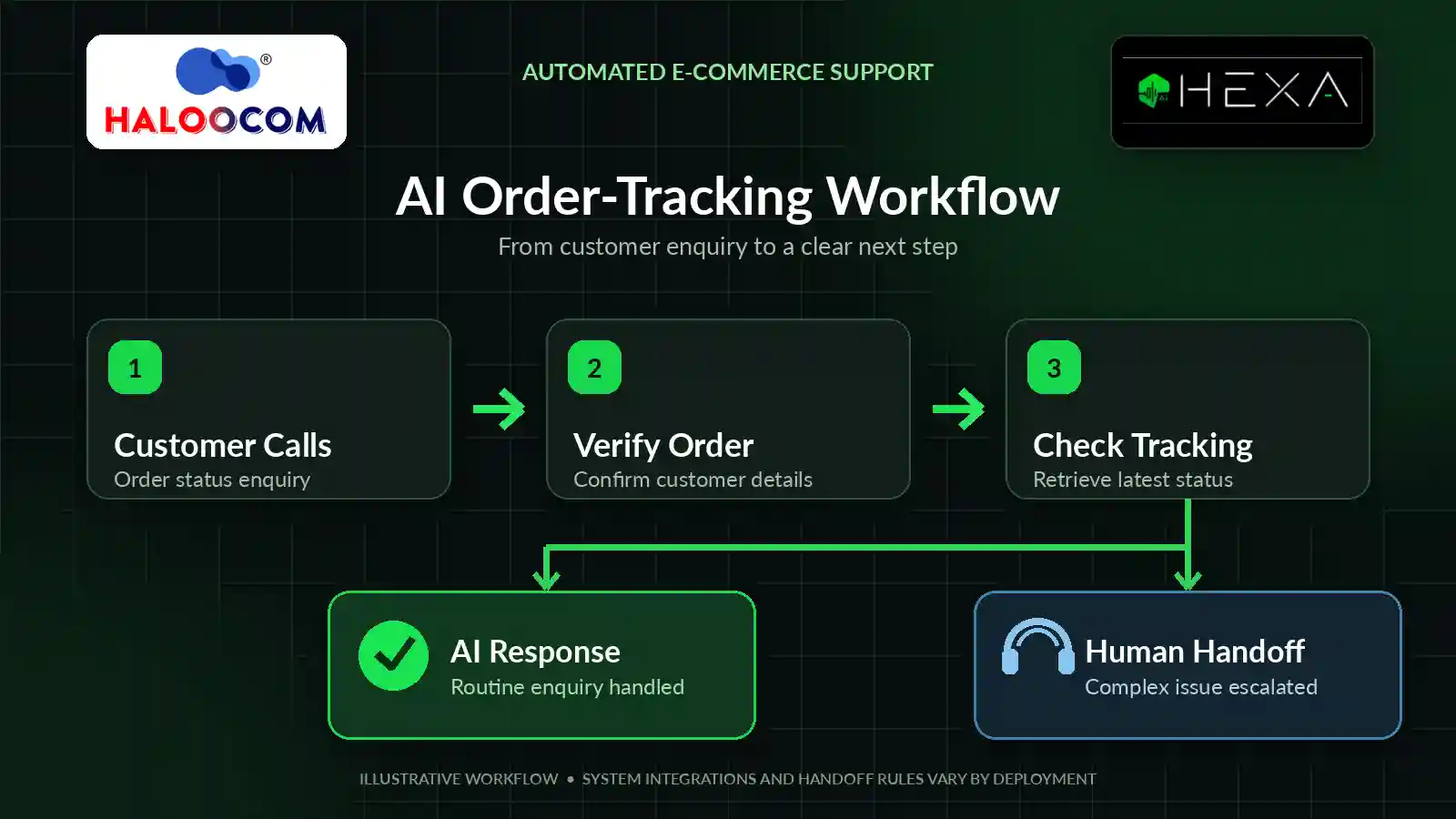
Haloocom AI-powered order-tracking workflow for ecommerce supports customers from inquiry to status updates.
What Happens When an AI Voice Agent Cannot Resolve an Enquiry?
Not every delivery-related conversation has a straightforward answer.
A customer may report receiving the wrong product, dispute a delivery confirmation or request a change that cannot be completed automatically.
In these situations, an AI voice agent should not attempt to resolve the issue without the required information or permissions.
Instead, the workflow should support escalation to an appropriate human agent.
For example, consider a customer whose tracking status says “Delivered”, but who has not received the package.
The AI agent may verify the order and communicate the recorded status. However, investigating the missing delivery may require human involvement.
A properly designed escalation process should help the next agent understand the customer’s issue without unnecessarily repeating the entire conversation.
The objective isn’t to eliminate human support. It’s to automate suitable enquiries and direct more complex cases to the right people.
What Systems Are Needed for AI-Powered Order Tracking?
An AI voice agent needs access to reliable business information to answer delivery-related questions accurately.
Without the necessary integrations, it may be able to explain general delivery policies but cannot reliably confirm an individual shipment’s current status.
Businesses evaluating order-tracking automation should consider four important components.
1. Order Management System
An order management system (OMS) provides information about orders, processing stages and fulfilment.
Connecting this information to a voice agent can help it identify the relevant order and retrieve available updates.
2. Logistics or Courier Tracking System
Courier and logistics platforms provide shipment milestones, delivery attempts and tracking updates.
These records help determine what information can be shared with the customer.
3. CRM or Customer Support Platform
A CRM or support platform can help maintain customer context, record interaction outcomes and support agent follow-ups.
The available functionality depends on the integration and data-sharing arrangements.
4. Workflow and Escalation Rules
Businesses need to define what the AI agent can answer, which actions it may perform and when it must transfer a conversation.
For instance, an agent may be permitted to communicate a delivery estimate but not independently change a shipping address.
These rules help keep automation aligned with existing operational processes.
What Should Indian E-commerce and Logistics Businesses Consider?
Voice automation in India requires more than answering questions in English.
Customers may prefer Hindi or other regional languages, especially when discussing delivery instructions or explaining an issue.
Multilingual voice capabilities can help businesses communicate with customers in familiar languages, provided the chosen solution performs reliably in those languages.
Businesses should test how an AI agent handles different accents, interruptions, mixed-language conversations and common logistics terminology.
Customer Data and Calling Compliance
AI calling workflows may involve customer phone numbers, order information and delivery details.
Companies should review how this information is accessed, processed and protected.
For outbound communication, businesses must also consider the applicable rules for commercial, service and transactional calls.
The Telecom Regulatory Authority of India (TRAI) has established requirements relating to commercial communications, consumer preferences and sender registration.
In 2026, TRAI also initiated phased implementation of the 1601 numbering series for service and transactional calls involving eligible courier and logistics entities.
The specific requirements depend on the calling purpose, entity and applicable regulatory framework.
Businesses should validate their proposed calling workflows with their telecom and compliance teams before deployment.
How Can Businesses Measure the Impact of AI Voice Calling?
Implementing AI voice agents should begin with a clear operational objective.
For one e-commerce company, the priority may be handling routine order enquiries. For a logistics provider, it may be improving communication after unsuccessful delivery attempts.
Businesses can evaluate automation through measurable indicators.
| Performance metric | What it helps measure |
| Automated resolution rate | Share of eligible enquiries completed without human assistance |
| Order-status call volume | Number of customer calls related to tracking |
| Outbound call completion rate | Share of initiated calls that reach the defined completion stage |
| Human escalation rate | Frequency of cases requiring agent intervention |
| Cost per resolved enquiry | Total relevant support cost divided by resolved enquiries |
| Customer satisfaction | Feedback on the support experience |
For example, an e-commerce business could compare its order-tracking enquiry workload before and after introducing automation.
It could also measure how many calls the AI completes successfully and how often customers still require human support.
These measurements provide a more reliable assessment than assuming every automated call creates a cost saving.
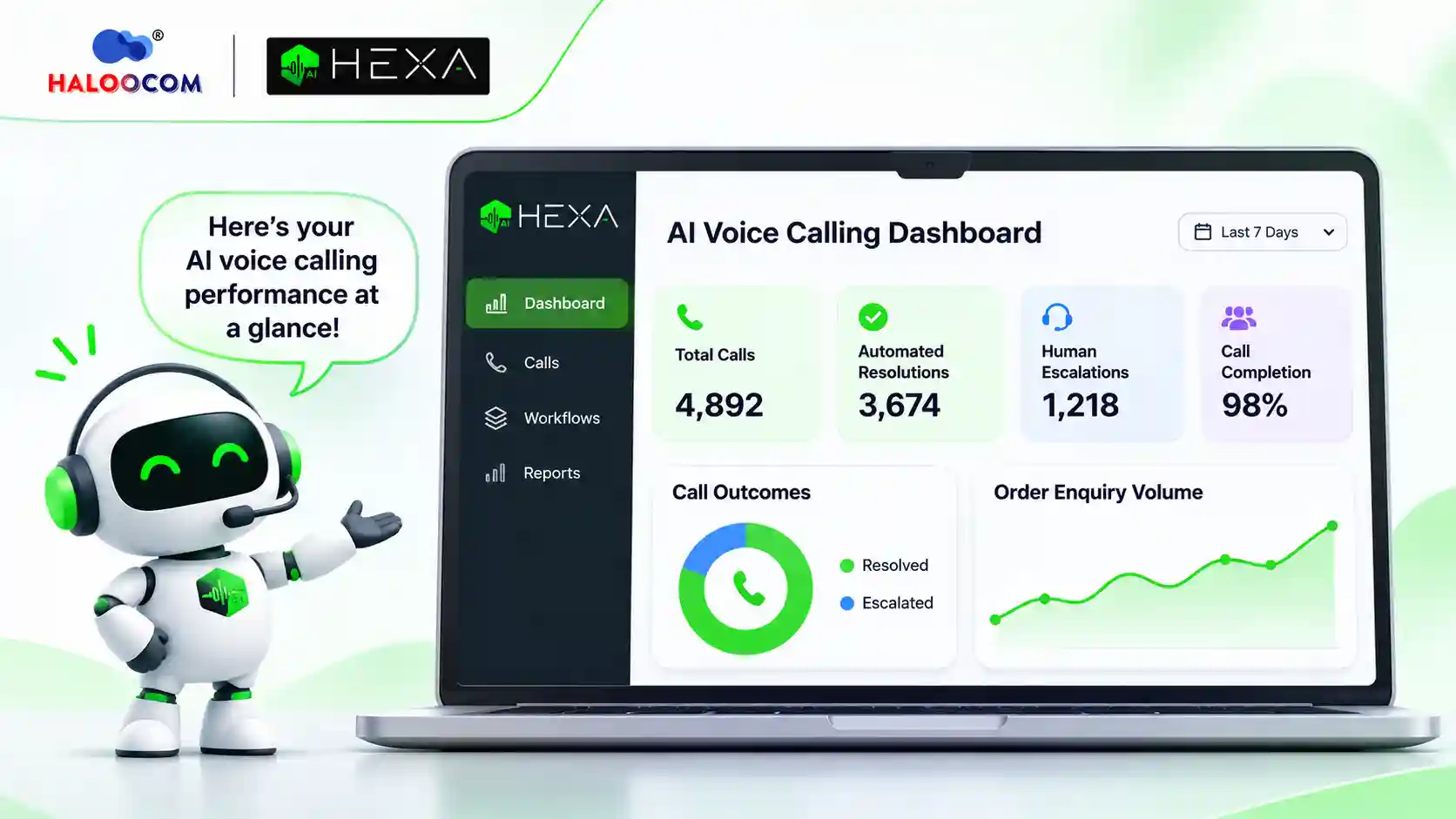
AI voice agents dashboard showing calls, resolutions, and order tracking metrics.
How HEXA AI by Haloocom Supports E-commerce Customer Communication
For e-commerce and logistics businesses exploring voice automation, HEXA AI by Haloocom provides an enterprise AI voice agent platform for inbound and outbound customer conversations.
HEXA is designed to help businesses automate repetitive calling workflows, communicate in multiple languages and connect AI conversations with existing business systems.
Its relevant capabilities include:
- Inbound AI calling: Handle routine customer enquiries through conversational voice interactions.
- Outbound automation: Support reminders, confirmations and approved customer follow-up workflows.
- Multilingual conversations: Communicate with customers in supported languages.
- Business integrations: Connect AI calling workflows with relevant enterprise systems, subject to integration requirements.
- Human agent handoff: Escalate enquiries that need additional assistance.
- Call analytics: Track interactions, outcomes and campaign performance.
For an e-commerce operation, HEXA can be evaluated for workflows such as order-status enquiries and delivery-related follow-ups.
The exact functionality depends on the available order data, integration requirements and configured workflow.
Rather than treating every customer call as a manual task, businesses can identify repetitive interactions where AI voice automation may be appropriate.
Building Better E-commerce Customer Experiences Through Voice Automation
Customers want accurate information about their orders, especially when deliveries are delayed or require additional attention.
For e-commerce and logistics businesses, meeting these expectations becomes more challenging as customer interactions increase.
AI voice agents for e-commerce provide a way to handle routine order enquiries, support delivery communication and connect customers with human agents when necessary.
The most effective approach is to start with a clearly defined workflow, reliable tracking information and measurable service goals.
Frequently Asked Questions
1. Can AI voice agents provide real-time order-tracking information?
Yes, provided the AI voice agent is connected to an order management or logistics tracking system that supplies current information.
The agent can retrieve available shipment details and communicate them to customers. The accuracy and freshness of the response depend on the connected system and how frequently its tracking data is updated.
2. Can AI voice bots automatically notify customers about delivery delays?
AI voice bots can support automated delivery notifications when connected systems provide appropriate events or triggers.
For example, a recorded delivery delay could initiate an approved outbound call. Businesses need to configure calling rules, customer-contact permissions and escalation options before using this type of automation.
3. Do AI voice agents need to integrate with logistics management systems?
For personalised order tracking, integration is generally necessary.
Without access to relevant order or shipment information, an AI agent cannot reliably confirm an individual delivery’s current status. Businesses should assess their order management system, courier tracking APIs and CRM requirements before implementing automated order enquiries.
4. Can AI voice agents support Hindi and regional Indian languages?
Multilingual AI voice agents can support conversations in different languages, depending on the platform.
HEXA AI offers multilingual voice capabilities, including Indian languages. Businesses should confirm the required languages and test conversation quality, local accents and mixed-language enquiries before deploying an agent for customer communication.
5. What happens when an AI voice agent cannot resolve a delivery enquiry?
A properly configured AI voice workflow should offer human escalation when an enquiry requires further investigation.
For example, a missing package complaint or disputed delivery may need a support agent to review the shipment. Where supported, relevant conversation context can be passed to the human team.
6. Are automated delivery calls allowed in India?
Automated calling must comply with applicable Indian telecom regulations and customer communication requirements.
TRAI’s rules address commercial communications, consent, recipient preferences and registered calling arrangements. The requirements can differ between service, transactional and promotional calls, so businesses should confirm the applicable rules before launching outbound campaigns.
Simplify E-commerce Customer Communication With HEXA AI
Managing routine order enquiries and delivery follow-ups doesn’t have to depend entirely on manual calling.
HEXA AI by Haloocom helps enterprises explore AI-powered inbound and outbound customer communication workflows.
Want to see how AI voice agents could fit your e-commerce or logistics operations?
Email: enquiry@haloocom.com